|
| Artists and visitors are inspired by the views from Cordes-sur-Ciel. |
My sister has come up with the perfect idea for a little sisterly getaway. So one recent weekend, we head to the heart of the Occitainie region to learn to forage and cook vegan cuisine. Our destination is the achingly pretty village of Saint-Antonin-Noble-Val. But before we settle in for the night at our bed & breakfast, we head a bit further down the road to the absurdly lovely village of Cordes-sur-Ciel.
 |
| Stone and sky are some of the charms of Cordes-sur-Ciel. |
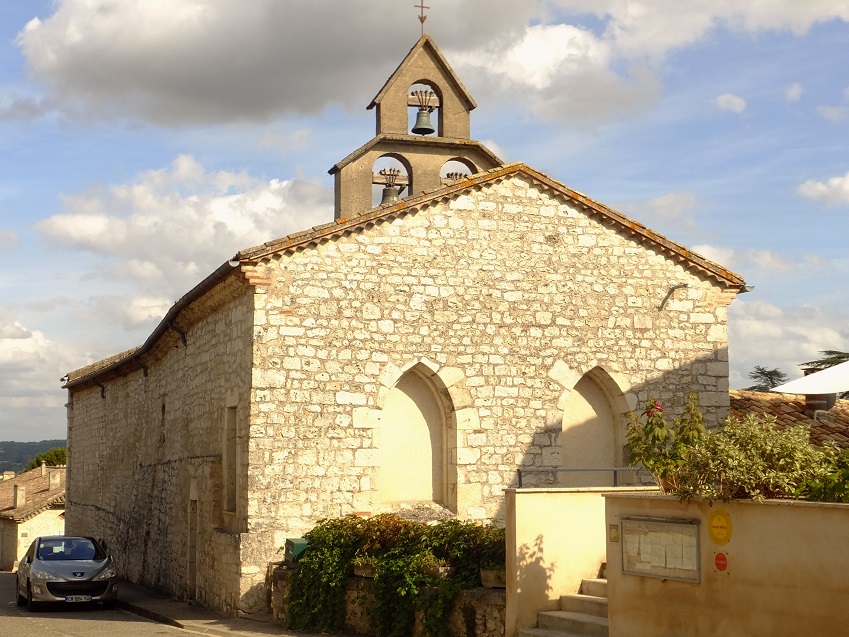
Cordes has been on my must-visit list for a long time. This Gothic-style town is one of the oldest bastides in Occitania. Its name, Cordes-sur-Ciel, translates to "ropes on the sky." The village is perched atop the Puech de Mordagne ridge, and although the views from Cordes are fantastic, the most iconic views of the village would be from a neighboring hill. In the right weather, Cordes seems to float above the clouds.
 |
| This charming vegetarian restaurant, Sur les Pavés in Cordes-sur-Ciel, offers a delicious lunch assortment. |
I've made a lunch reservation at a little vegetarian café, Sur les Pavés, where, apparently, time has stood still since around 1972. As we admire the eclectic décor, and ponder our lunch choices, the owner/chef comes by to say bonjour and take our drink order. We are delighted to discover that the five dishes listed on the menu board aren't choices: Our lunch will include all of them. Yummy!
 |
| The streets of Cordes-sur-Ciel are quiet on this April afternoon. |
Cordes-sur-Ciel has a rich heritage, which I'll skip for this post. I am determined to return soon and explore as many of the 22 villages of the Cordais and Causse area with my husband. If we don't get there before summer, I'll aim for autumn, after the tourists depart and the leaves start to turn. Maybe we'll even luck out and get to see the village floating in the sky.
After lunch, my sister and I head to Saint-Antonin-Noble-Val, our home and culinary classroom for the weekend. We're the only guests staying at the lovely chambre d'hôte Le Cheval Blanc. We're greeted by our host who shows us to a spacious room that oozes Old World charm. He suggests we take advantage of the break in the weather and explore the village before dinner. He tells us to be sure to look up, as there are lots of gargoyles hanging about. (Unfortunately, we spot not a one.)
 |
| This carving above a door in Saint-Antonin-Noble-Val gave la Maison de l'Amour its name. |
Saint-Antonin-Noble-Val has long been a popular village with tourists, but with the 2014 food porn film, "The Hundred Foot Journey," the town has become a culinary destination. The movie's plot involves a family of immigrants from India who establish a restaurant across the street from an upscale establishment run by an uptight Helen Mirren. Comedy, food, and romance ensue.
 |
| This medieval-style garden was created in 2009 in Saint-Antonin-Noble-Val. |
The story of how our hosts, Peter and Nathalie, came to Saint-Antonin is reminiscent of the film's story. According to Peter, Nathalie's bike broke down a few kilometers outside of the village. They walked to Saint-Antonin, fell in love with the place, and eventually opened Le Cheval Blanc. I don't watch British television, but several friends here in France are acquainted with Peter and Nathalie through a TV series that features them from time to time. In addition to a B&B, Le Cheval Blanc is a restaurant, cooking school, and purveyor of bike holidays.
(An aside: Peter bought a car from dear friends of ours. The distance from Saint-Antonin to our friends' village is about 150 kilometers. Peter rode his bike to pick up the car. As the Brits say: Crikey!)
 |
| Auberge du Lion d'Or is an 18th century inn in Saint-Antonin-Noble-Val. |
Following the route suggested on a tourist map, my sister and I manage to see all the village highlights in about two hours. We return to our hotel in time for dinner — an incredible vegan meal adorned with edible flowers.
 |
| The scene above the entry to the 19th-century Neo-Gothic church in Saint-Antonin-Noble-Val catches my eye. |
Saturday morning, after helping ourselves to several cups of coffee and enjoying another delicious meal prepared by Nathalie, we're off to the countryside to learn about foraging for food. Our guide is Stephane, botanist-extraordinaire. We roam through the fields collecting various leaves and flowers, which we'll cook with later. I almost immediately forget much of what Stephane tells us, but a few days after getting home, I receive an email with photos and plant descriptions. One tip that I do remember: If I'm going to forage, I should invest in a good plant book. Also, just because a plant looks edible, it doesn't mean it is.
 |
| This vine-covered bench is located in a garden near Saint-Antonin-Noble-Val. |
Our menu will depend on what we're able to forage and today's haul is rich in stinging nettles. I learn why the plant has that name. (Here's another tip: Wear gloves while foraging. My fingers hurt like hell for a full day.) Later, back at Le Cheval Blanc, Nathalie guides us as we turn nettles into delicious soup, pesto, and even cake.
 |
| The rain holds off until after we forage for our Le Cheval Blanc cooking workshop in Saint-Antonin Noble-Val. |
 |
| Stephane, our French plant guru, guides us through the Saint-Antonin-Noble-Val countryside. |
 |
| My sister's vegan pizza is a delicious hit at our Le Cheval Blanc cooking workshop in Saint-Antonin-Noble-Val. |
 |
| The pea fritters take some concentration at our Le Cheval Blanc cooking workshop in Saint-Antonin-Noble-Val. |