Showing posts with label Eastern Europe travel. Show all posts

Tuesday, April 29, 2025

Unforgettable Krakow

Cloth Hall is the centerpiece of Rynek Glowny, Krakow's main square.

This post is full of pictures — about twice as many as usual — thanks to the glorious spring weather my sister and I were graced with on our recent trip to Krakow. (I take much better photos when the sky is blue.) We recently spent three days exploring this beautiful city in southern Poland. Krakow was spared the destruction many European cities received in World War II because of its quick surrender to the Nazis, thus, many splendid old buildings are intact. The city boasts a huge central square, great museums, churches, a massive palace, and hearty delicious cuisine. I'll write about the most impactful part of our visit — a tour of Auschwitz and Birkenau — at the end of this post. 

The trees are blooming during our early spring visit to Krakow.

Our flight from Paris arrives early, and it's an easy train trip into the city where we have several hours to explore before we can check in to our apartment. We head to Kazimierz, the old Jewish quarter. The neighborhood is known these days for its trendy boutiques, galleries, and bars, as well as its lively nightlife. 

But we're here at noon, so our minds are on lunch. We could not have found a more kitchy place than the colorful restaurant offering an array of pierogi. We nearly pass on it, but I'm charmed by the waitresses in their traditional Polish costumes. The little dumplings are delicious and extremely filling. 

Kazimierz is also where you'll find Poland's oldest synagogue, the Jewish Museum, the Galicia Jewish Museum, the Remuh and New Jewish cemeteries, and several notable churches.     

We pick this colorful place for lunch on our first day in Krakow.

Usually filled with potatoes and cheese, the pierogi in
Krakow are offered with an array of fillings. 

Since our backpacks are getting heavy, we head back towards our apartment, stopping for a coffee in the city's main square. Krakow's Rynek Glowny is the 40,000-square-foot centerpiece of the city's medieval Old Town. Sukiennice Cloth Hall stands in the center. Once a hub of commerce and trade, the long hall contains dozens of souvenir and craft shops. Ringing the plaza are restaurants and bars. St. Mary's Basilica is situated on the west side of the plaza, and Town Hall Tower stands at the southern end.  

Town Hall Tower is the only remaining section of
Krakow's 13th century town hall.

'The Head' is a controversial art piece located in Krakow's Main Square.

Underneath Cloth Hall, a new museum has been created from the archaeological excavation of the plaza that began in 2005. Foundations of market stalls, workshops, and a cemetery were unearthed, along with valuable objects from the 13th-14th centuries. Instead of relocating these discoveries to a museum, the city built a museum on top of the excavation site that visitors can access via Cloth Hall. Rynek Underground Museum is fascinating, but rather confusing. 

A hologram of a medieval craftsman is tucked in a corner
at Rynek Underground in Krakow.

We would have been well served getting an audio guide or reading up a bit before going. We spend a lot of time looking at rocks and soil layers before we get to the good stuff. It's dark in here and the signage and exhibition layout map are nearly impossible to read, although there are dozens of touchscreens that provide detailed information. Towards the end of our visit, we find a series of rooms showing films that depict the history of Krakow. I would have rather viewed these films at the start of our visit. 

Remains of 14-th century traders' stalls are
featured at Rynek Underground in Krakow.

Films depicting life in Krakow through the centuries are shown in
what were once the cellars of the Rich Stalls at Rynek Underground. 

We've scheduled a morning visit to Wawel Castle. Our stroll there takes us past several notable sites including the former home of Pope John Paul II, a beloved figure in Krakow. 

This mosaic of Pope John Paul II is located at the
Episcopal Palace, where he lived when he was
Archbishop of Krakow. 

Twelve apostles stand in front of Saints Peter and Paul Church
in Krakow. It may be Poland's oldest Baroque-style building. 

We see Sandomierska Tower on our way up Wawel Hill in Krakow.

Wawel Hill is considered to be Poland's most important historic and cultural site. Wawel Castle, a cathedral, several exhibitions, a tower, and even a dragon's den are found here, all of which can be visited separately. The castle was home to Polish kings for centuries, and today it is one of the country's premier art museums.

It's a beautiful spring morning on Wawel Hill in Krakow.

We've booked access to the castle's first and second floors and are given an audio guide upon our arrival. The guide has been extremely well designed. Highlights in each room are explained, and we are invited to take our time before moving on to the next room. Since our "guide" can sense where we are, it's almost as if we're on a personal tour with an actual human. I'm kind of wistful when our tour is over and we have to say goodbye. 

Tapestries from the Sigismund II Augustus collection are
displayed at Wawel Castle in Krakow. 

We admire the detail of a decorative heater at Wawel Castle in Krakow.

Krakow is relatively flat, but I find a good city view from a
window at Wawel Castle.

This gold ceiling is located in the Royal Apartments at Wawel
Castle in Krakow. 

Senators Hall, also known as Dancing Hall, is the largest room
in Wawel Castle in Krakow.

The Vistula River and beyond are seen from Wawel Hill in Krakow.

So much sightseeing means we need to power up from time to time. Polish cuisine is very hearty, but there are many options for vegetarians in Krakow too. Our apartment is a block away from Stary Kleparz market hall where we find an array of products we wish we had room in our luggage to take home. My sister does manage to fit some cottage cheese in her back pack. 

Cottage cheese, incidentally, is the preferred topping for bagels here. Although bagels were invented in Krakow, they aren't as popular as obwarzanek krawkowski, a braided ring of dough much like a bagel (but not as good, in my opinion). My sister and I decide to take a class in making these decidedly local snacks at the Zywe Muzeum Obwarzanka, or Krakow Bagel Museum. 

Another hearty meal in Krakow is this huge potato pancake
smothered with goulash. 


Stary Kleparz is a Krakow market hall filled with tempting foods.

We show off the obwarzanek krawkowski that we made at the
Krakow Bagel Museum. This popular local snack 
is sold on 
nearly every street corner.


The Barbican in Krakow is a premier example of medieval military
architecture in Europe. 

Old Town Krakow is ringed by Planty Park, a welcoming place to take a break.

We've booked a tour of Auschwitz and Birkenau through KrakowTrip.com. The driver picks us up at our apartment just before 8 a.m., and we're joined in the van by three other couples. The drive to Auschwitz takes about an hour and a half. The parking lot is packed with tour busses and cars. We're told that around 10,000 visitors will be visiting today. It's gratifying to see so many people, the school groups in particular, who have come here to bear witness. 

We're merged with some other groups so there's around 30 of us, and we have a dedicated guide. We spend several hours winding our way through the buildings and grounds of the largest of the German Nazi concentration and extermination camps. Great care has been taken with preserving and displaying the camp. Unfortunately, it would be very challenging for those with limited mobility to take this tour, as there are a lot of stairs. We continue on to Auschwitz II-Birkenau, where around 90% of the Auschwitz prisoners were killed. 

I do not take any photos during our visit. I won't need them to remind me of what I see here. This is a pilgrimage that everyone should make, and it should be a mandatory prerequisite for all world leaders. 

For more information, visit the Auschwitz Museum and Memorial website, Auschwitz-Birkenau.


Monday, November 1, 2021

Prague's buildings contain delightful details


A sundial is featured on the wall of this building in the Vinohrady quarter.

I'm straying from my usual format in my second post about our recent trip to Prague, capital of the Czech Republic. The old city center escaped a lot of damage during WWII, so what remains is one of the most well preserved cities in Europe. 

Since the city is so clean and doesn't contain a huge amount of dog doo, I didn't have to constantly watch where I stepped. Therefore, I was able to look around and upward during our strolls of Prague's streets. 

Rather than offer you a lot of detail about these photos, I only include captions on identifiable landmarks. Užívat si! Enjoy!


Prague's Municipal House


This statue of the Black Madona is perched on a
notable cubist building in Prague.


The room with this window on the Karolinum building
of Charles University is where ceremonies are held. 


Prague's Old Town Square

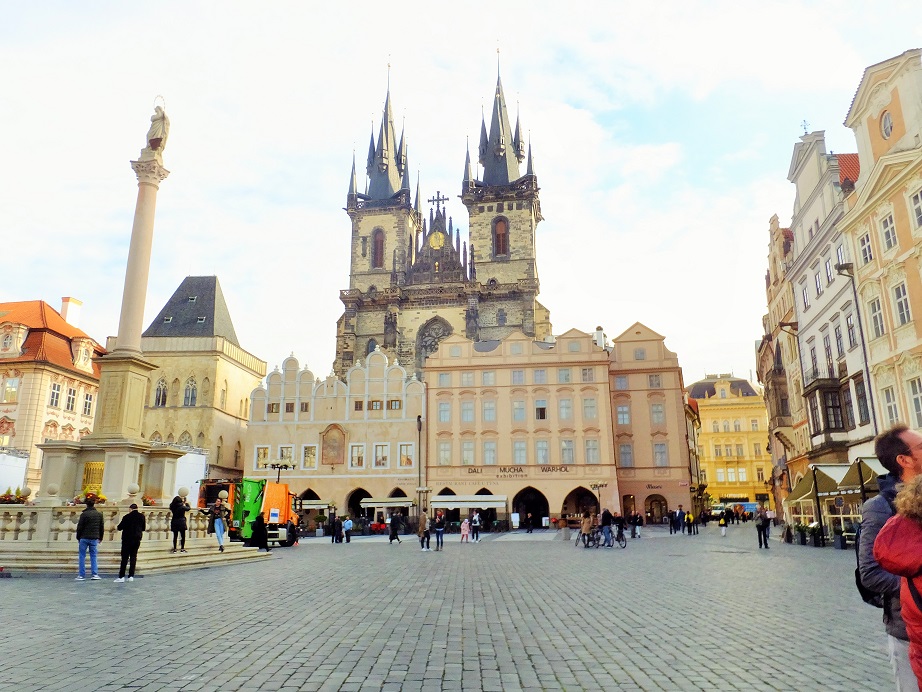
If you want to go inside the Church of Our Lady before Týn,
enter through the pizza restaurant in Old Town Square.

Prague's Old Town Square

Prague's Old Town Square


Prague's Dancing House is also called 'Fred and Ginger.'


Friday, October 29, 2021

Time to check out Prague

Prague Castle is seen from the náměstí (plaza) by the Charles Bridge.

Recently, we (my husband, my sister, and I) took advantage of a pretty good airfare and went to Prague for a few days. Prague, or Praha, is located in the Czech Republic, the country formerly known as Czechoslovakia, which is much harder to spell. Before it was Czechoslovakia, the country was the kingdom of Bohemia. 

This mural above the entry to Prague's Municipal House
depicts a Bohemian scene entitled 'Homage to Prague.'

The Czech Republic is a member of the European Union, but it has its own currency, the koruná česka (Kč), or Czech crown (CZK). Currency confusion is probably the biggest challenge we encounter during our visit. I wondered why the Czech Republic hasn't converted to the euro, so I checked online; according to the Kafkadesk website, the reasons are political along with a hefty dose of national pride. 

This is the only picture I take in Wenceslas Square. This part
of Prague is touristy, crowded, and not really our scene.

To add to currency confusion, we were warned to be wary of the many ATMs and currency conversion offices. We were specifically advised to not convert any money at the airport. Instead, we take our AirBNB host's advice and change some euros (cash only) to Czech crowns at a bureau de change on Jindrisska Street near the Post Office. Most restaurants and ticket machines for the buses, trams, and subways accept credit cards. (Be sure to ask beforehand, as we eat our last meal in Prague at a waffle place that only accepts cash. As we have efficiently just spent the last of our crowns, we find ourselves in a bind. Luckily, the restaurant accepts our euros.)

We meet our tour guide by Prague's Powder Tower,
one of the city's original gates.

On the morning after our arrival, after fumbling our way through currency conversion and incomprehensible street names, we meet our guide from Free Tours on Foot for a three-hour tour of the city. Ken and I always try to go on a walking tour when we visit a city for the first time, and this tour turns out to be above average. We see some of the most famous sites of Prague as well as some lesser known, learn a little history, and receive tips on where to eat and more sites to hit during our stay. 

Old Square in Prague is a vast area ringed by buildings
from the 14th through 19th centuries.

Prague's Astronomical Clock puts on an under-whelming hourly
show, but it's a fascinating work of engineering. Installed in 1410,
it is the oldest working clock of its kind.  

The Karolinum is the seat of Charles University
in Prague. Tuition to universities in the Czech
Republic is free  — but you must speak the language.

Once known as the Crying Wall, the Lennon Wall in Prague has
become a symbol of free speech, peace, and resistance to communism. 
 
The Lennon Wall is the only place in Prague where graffiti is legal.

Another challenge is language. I tried to memorize some Czech phrases in the weeks before our trip, but I wasn't too successful. Most Czechs who are younger than 50 speak English, and lots of the signs and menus are in English. I have to pull out my "cheat sheet" of Czech food — both dishes-to-try and dishes-to-avoid — at one restaurant. Czech cuisine emphasizes meat, although Prague is becoming known for its vegetarian and vegan restaurants. Despite this, my vegetarian sister has cheese for her main dish, three meals in a row: two times fried and once pickled. The city has a ton of ethnic restaurants too, and the dish I most enjoy during our trip is at a Vietnamese restaurant.


The Loreto is a beautiful baroque monastery located in
Prague. It's a replica of the Holy House of Loreto in Italy,
and is a popular Catholic pilgrimage destination. 

St. Vitus Cathedral in Prague is the city's most important
church. About 40 percent of Czechs consider themselves
to be Catholics, and another 40 percent are atheists.

As we leave the Prague Castle complex, we see the spires
atop St. Vitus from a different angle.

We head back down the hill from Prague's Hradčany
quarter via Královská zahrada (the royal gardens). 

Our apartment is located in Vinohrady, a beautiful residential neighborhood, a short walk to the old town. And walk, we do! In fact by the end of our first full day in Prague we are wiped out. The next day, we decide to master the metro. Turns it, it's pretty easy, inexpensive, safe, and clean. We kick ourselves for not using mass transit the day before. 

Ken patiently waits for our subway to arrive in a Prague metro station.

A delicious highlight of our trip is a Saturday morning visit to the Naplavka market along the shores of the Vltava River. In addition to stands selling (cash only!) produce, baked goods, and crafts, there's a section of clothing vendors and, of more interest to us, there's an array of offerings for lunch. Before deciding what to eat, we cross the river and peruse more food stalls. Bingo! My sister scores a grilled mackerel, Ken gets some Asian soup, and I have tater tots — that's right! — tater tots, with wasabi and guacamole sauce. We buy some beverages from one of the bars embedded in the walls under the roadway, and enjoy our unusual market lunch.

I'm talked into trying these tater tots by a vendor from New Jersey.
My sister has fish on a stick.


Bars like this one are built right into the walls under the streets
beside the Vltava River.

Swans cruising the Vltava River seem to know that it's market day.

Palackého Most is just one of many bridges that span the
Vltava River in Prague.

We take an unexpected detour uphill and are rewarded
with this view from behind the Prague Castle.

The Vinohrady Water Tower is no longer a water tower.

Once a market hall, the Vinohradsky Pavillion now houses
an interior design gallery.

For the life of me, I can't figure out what
this poster in a store window says.

I'm amused by this sign on a 'dog lawn' in Prague.

Feeling anything but Kafkaesque during our
long weekend in Prague, we stop to pose
by the Kafka statue.

On our last morning in Prague, we take the metro to the Jewish Quarter. Two days earlier our guide had advised us to only buy tickets at the official ticket office, and the website for Jewish Quarter said that everything opened at 9. Wrong on both counts. The Jewish Museum, which includes five synagogues, the Ceremonial Hall, and the Jewish Cemetery, opens for visitors at 10, and no one showed up at the ticket office. But, we are able to buy our tickets at the entrance to the Ceremonial Hall. Our tickets give us access to all the sites except the Old-New Synagogue, which requires another ticket and which we won't have time to visit anyway. (Note: The sites in the Jewish Quarter are closed to the public on Saturdays and on Jewish holidays.)

Prague Castle can be seen through a gate in the city's Jewish Quarter.

The walls inside Jewish Ceremonial Hall are covered with the names of the millions of Jews who died in the holocaust. The building also houses an exhibit of children's artwork and stories depicting life in the Jewish Ghetto and in the Terezin concentration camp located to the north of Prague. Outside we look at several large panels of photographs from this sad era, before walking through the Old Jewish Cemetery. One of the largest Jewish cemeteries in Europe, this is the burial place of between 12,000 and 100,000 people.  


A burial site for more than 300 years, Prague's Old Jewish
Cemetery contains the graves of tens of thousands of Jews.

Because Jewish law forbids the destruction of graves, the
Old Jewish Cemetery in Prague was expanded upward,
with remains being put to rest on top of other remains.
There are sections here with as many as 12 layers of graves.

The interior of the Spanish Synagogue in
Prague is surprisingly shiny.

In this post, I've included photos of some of the highlights of Prague. In another post coming along very soon, I'll share lots of pictures I took of the marvelous architectural treats found in Prague. 


I snap one last picture of the Prague skyline before heading home.

I must mention that I received a ton of useful information about Prague prior to our trip by watching the Honest Guide series on YouTube. Check it out if you're planning a trip to Prague.